
plasma Textile
Eco-Efficient Functionalization
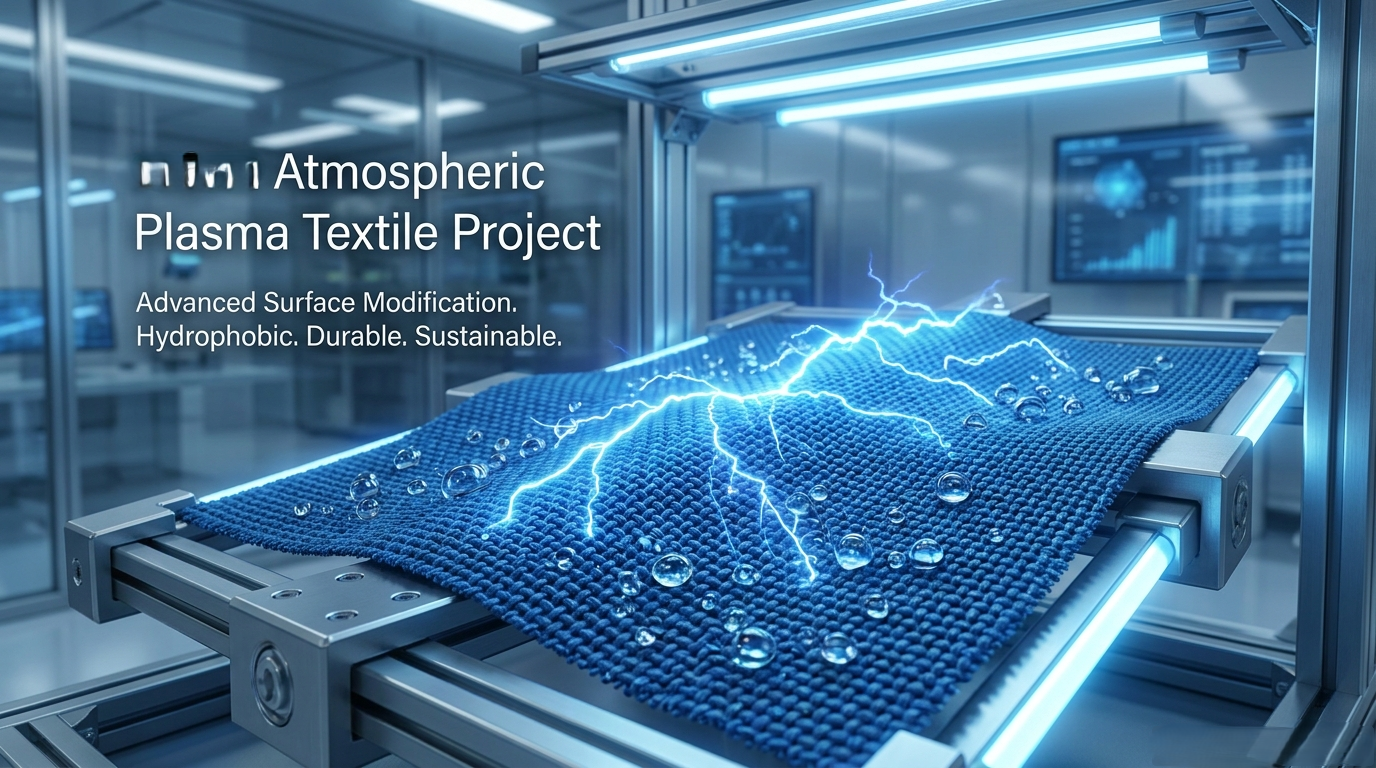
Atmospheric Plasma Technology for Advanced Surface Functionalization
This Project represents a key research initiative in eco-efficient surface engineering for high-performance textiles. Designed as a preliminary feasibility study for broader multi-functional textile applications, the project explores dry atmospheric plasma treatments to achieve durable waterproofing and stain resistance across both natural and synthetic fibers without altering the core physical properties of the material.
Project Overview & Objectives
Traditional textile finishing processes rely heavily on wet chemical baths, requiring high thermal energy, large volumes of water, and extensive drying cycles. The FISTI project evaluates dry, solvent-free Dielectric Barrier Discharge (DBD) atmospheric plasma as a clean alternative.
The primary objectives of the study include:
- Enabling Eco-Efficient Functionalization: Developing a dry, solvent-free surface treatment method that minimizes energy consumption and eliminates industrial wastewater.
- Selective Surface Modification: Altering the chemical composition and nanometric roughness of the outermost fiber layers while preserving the bulk mechanical strength, breathability, and feel of the fabric.
- Substrate Versatility: Testing and validating plasma activation protocols across complex fiber structures, including cellulosic matrices (cotton microfibrils) and proteinic networks (wool keratin and disulfide bonds).
- Industrial Roll-to-Roll Integration: Establishing process parameters directly scalable to continuous commercial textile finishing lines.
Pilot Plant Architecture & Process Parameters
Experiments were carried out using a specialized pilot-scale DBD plasma plant designed to mirror commercial manufacturing conditions:
- System Configuration: Continuous horizontal parallel-electrode reactor capable of processing fabric rolls with a width of approximately 60 cm.
- Line Speed & Power: Adjustable mechanical roll-to-roll line speeds ranging from 1 to 10 m/min, powered by a continuous/pulsed generator supplying up to 10 kW.
- Multi-Gas & Precursor Delivery: Flexible gas manifold system allowing the introduction of up to 4 technical process gases alongside 2 vaporized liquid precursors and an additional atomized monomer directly into the plasma discharge volume.
- Activation Parameters: Treatment trials utilized an oxidizing gas atmosphere designed to convert amide functional groups into active hydrocarbon radicals.
Key Findings & Performance Results
Characterization of the plasma-treated fabrics demonstrated significant improvements in surface energy and chemical reactivity:
- Dramatic Increase in Surface Energy: While untreated natural fabrics exhibited initial water resistance due to surface scales and air trapped in the weave, plasma activation transformed the surface energy, resulting in complete, immediate wettability (super-hydrophilicity).
- Active Binding Sites for Finishes: The creation of dense, uniform active chemical sites across the fiber surface ensures superior bonding chemistry for subsequent hydrophobic (water-repellent) and oleophobic (oil-repellent) finishing agents.
- Enhanced Wash Fastness & Durability: Pre-conditioning the textile matrix with atmospheric plasma significantly improves the adhesion, uniformity, and long-term laundering resistance of functional coatings compared to non-activated fabrics.